How to Remove Mould From Walls Professionally
A few black specks on a painted wall can turn into a much bigger problem faster than most people expect. If you are searching for how to remove mould from walls professionally, the real goal is not just making the stain disappear. It is removing active growth safely, protecting indoor air quality, and dealing with the moisture source so the mould does not return a few weeks later.
That is where many DIY efforts fall short. Wiping the surface with supermarket spray may lighten the mark, but mould often sits deeper than the visible patch. In homes and workplaces across Adelaide, we regularly see mould linked to condensation, poor ventilation, leaks, wet carpets, damp plaster, or walls behind furniture that never properly dry out.
What professional mould removal actually involves
Professional mould cleaning is a controlled process, not a quick cosmetic wipe-down. The visible spotting on the wall is only one part of the job. A proper approach starts with identifying the extent of contamination, the wall material involved, and whether the moisture source is ongoing.
Painted gyprock, brick, rendered surfaces, timber trims and ceilings all respond differently. On a hard, non-porous surface, mould may be removable with targeted treatment and careful cleaning. On porous materials such as damaged plasterboard or insulation-backed wall systems, there is often a point where cleaning alone is not enough. If mould has penetrated the material, sections may need removal and replacement.
Professional technicians also assess risk. Small surface mould in a well-ventilated laundry is one thing. Extensive growth in a bedroom, office, or property affected by a leak is another. The larger the affected area, the more important containment, PPE, and safe removal methods become.
How to remove mould from walls professionally: the step-by-step approach
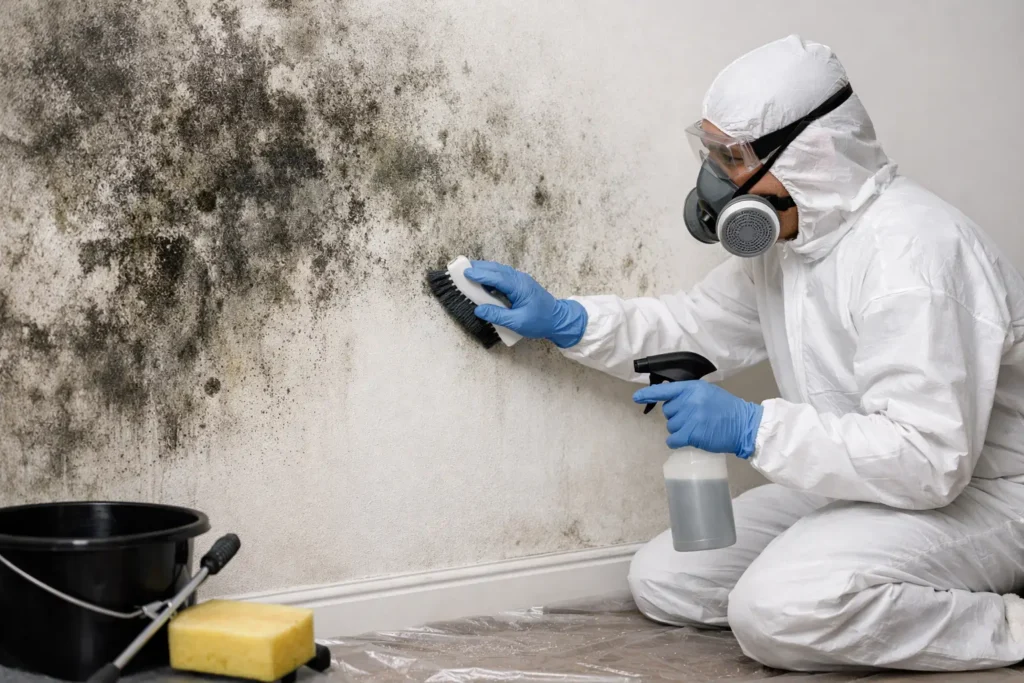
The professional method usually starts before any chemical is applied. The first priority is safety and containment. That means wearing suitable protective equipment, improving ventilation where appropriate, and reducing the chance of spores spreading into other rooms during cleaning.
Next comes inspection. This is where experience matters. A technician looks at the size of the affected area, whether the mould is dry or active, the condition of the paint, signs of bubbling or staining, and clues that point to hidden moisture. If the wall feels soft, flakes easily, or shows persistent water staining, the issue may go beyond surface cleaning.
Once the area is assessed, loose contamination is carefully removed. In some cases, this involves controlled dry removal with specialist filtration nearby. In others, the surface is treated first to reduce disturbance. The aim is to lift contamination without driving spores deeper into the surface or across the room.
The cleaning stage depends on the wall type. A professional-grade mould treatment is selected to break down growth and sanitise the surface while staying suitable for the material. This is one reason random household mixtures can create problems. Some products bleach the appearance without fully treating contamination, and others can damage paintwork or leave strong residues indoors.
After treatment, the wall is cleaned and dried properly. Drying matters as much as cleaning. If residual dampness remains in the wall cavity, behind furniture, or in adjacent soft furnishings, mould can return quickly. In more serious cases, moisture readings and follow-up checks are part of the process.
If there is staining left behind after mould is removed, that does not always mean active mould is still present. Sometimes the organism is gone, but the surface remains marked. Cosmetic restoration may require repainting once the wall is dry and stable. If repainting happens too early, moisture can become trapped and the problem often reappears.
Why bleach is not always the right answer
A common question from property owners is whether bleach will fix mould on walls. The short answer is: sometimes it improves appearance, but it is not always the best professional solution.
Bleach can be effective on some hard, non-porous surfaces, but many interior walls are porous or painted. On these materials, bleach may not penetrate deeply enough to address embedded growth. It can also cause discolouration, trigger fumes indoors, and give a false sense of success because the wall looks cleaner before the root issue is solved.
Professional mould removal focuses on suitability, not shortcuts. The product and method should match the surface, the contamination level, and the indoor environment. In family homes, rental properties, and workplaces, that also means choosing treatments with safety and ventilation in mind.
When DIY is reasonable and when it is not
There are situations where a small patch of mould can be handled safely by a capable person. If the area is minor, the surface is solid and washable, and there is no known leak or major damp issue, careful cleaning may be enough.
But it depends on the context. DIY becomes a poor option when the mould covers a larger section of wall, keeps coming back, affects multiple rooms, or appears after water damage. The same applies if anyone in the home or office has asthma, allergies, respiratory sensitivity, or a weakened immune system. In those situations, disturbing mould without the right controls can make the air quality worse before it gets better.
Property managers and business operators also need to think beyond the patch itself. Recurrent mould can affect tenant satisfaction, workplace presentation, odour control, and ongoing maintenance costs. A proper fix is usually more cost-effective than repeated surface cleaning.
The real cause is usually moisture
If you want to know how to remove mould from walls professionally and keep it gone, moisture control is the answer. Mould is a symptom. The source is usually excess humidity, condensation, water ingress, or inadequate drying after a spill or leak.
In Adelaide properties, we often see mould in bathrooms without strong exhaust ventilation, bedrooms where furniture is pushed hard against external walls, offices with poor airflow, and homes where a small roof or plumbing leak goes unnoticed for too long. Winter condensation is another major trigger, especially in tightly closed rooms.
That is why professional advice often includes practical prevention steps. Use exhaust fans during and after showers, open windows when weather allows, keep furniture slightly off cold external walls, fix leaks promptly, and make sure wet carpet, underlay, or soft furnishings are dried properly after water exposure. If indoor humidity stays high, a dehumidifier may help, but it is not a substitute for repairing the underlying issue.
What to expect from a professional service
A reliable mould cleaning service should explain what can be cleaned, what may need replacement, and what is likely to happen if the moisture issue is not addressed. Transparent quoting matters here. So does a method that is safe for occupied homes and practical for businesses that need minimal disruption.
You should also expect clear communication about results. No ethical operator should promise that every mould problem can be solved with one surface treatment. Sometimes the correct professional answer is that cleaning is only one part of the solution, and building repairs, ventilation improvements, or drying works are needed as well.
For local households and commercial premises, it also helps to choose a provider that understands interior surface care more broadly. Mould on walls often overlaps with damp odours in carpet, contamination on upholstery near external walls, or moisture issues affecting adjoining rooms. A more complete view usually leads to a better outcome.
How to stop mould coming back after cleaning
Even excellent cleaning will only hold if the conditions change. Once mould has been removed, the room needs to stay dry enough to prevent regrowth. That may mean changing daily habits, improving airflow, or fixing a building defect.
Bathrooms should clear steam quickly. Laundries need ventilation when dryers are running. Bedrooms benefit from consistent airflow, especially in cooler months. In offices, air-conditioning and ventilation systems should be checked if staff notice condensation, musty smells, or repeated wall spotting.
If mould has affected surrounding furnishings, those should be assessed too. There is little value in professionally treating the wall if a damp rug, mattress, or soft chair nearby is still holding moisture and odour. This is where an experienced indoor cleaning specialist can make a real difference. Inverclean approaches mould cleaning as part of a healthier indoor environment, not just a visual touch-up.
When mould appears, the temptation is to scrub first and ask questions later. A better approach is to treat it like the hygiene and moisture issue it is. The wall may only be the place where the problem is visible, and dealing with it properly can make the whole room feel safer, cleaner, and easier to live or work in.